
AIR FORCE – Edged weapons of the Air Force
Luftwaffe dagger – 1st and 2nd model II


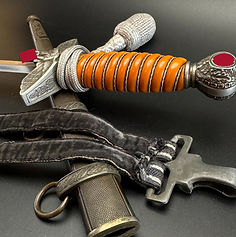
History & Introduction:
With the establishment of the Luftwaffe, it received its own edged weapons from 1935 onwards. The Luftwaffe dagger was introduced as a ceremonial sidearm for officers and was part of the dress and parade uniform. It was not intended for combat use.
Like other officers' daggers of the Wehrmacht, the Luftwaffe dagger was also privately procured. It was manufactured by numerous companies, predominantly from Solingen.
Models & Development:
Luftwaffe dagger, 1st model (1935)
The Luftwaffe dagger, model 1, was introduced in 1935. Typical features include:
-
round knob
-
Crossing bar as a wing
-
Blue Saffian/Morocco leather-covered handle with wire wrapping
-
Blue saffian/Morocco leather-covered scabbard with metal fittings
-
How to wear it: On a chain securely attached there with a carabiner clip
This model was only manufactured for a limited time.
Luftwaffe dagger, 2nd model (1937)
The second model was introduced in 1937 and replaced the first model, which could still be worn. It has the following features:
-
Oval knob
-
Crossguard: Luftwaffe eagle with outstretched wings
-
Plastic handle with wire wrapping
-
Silica-granulated metal sheath with circumferential bands
-
Wearing method: Hanger and sword knot
The wearing of the Luftwaffe dagger, model 2, was officially prohibited from December 1943.
Design & Dimensions:
Luftwaffe dagger, model 1 – design and construction
The Luftwaffe dagger of the first model features a grip covered in blue Saffian or Moroccan leather with a surrounding wire wrapping. The pommel and crossguard are made of nickel, German silver, or aluminum. Round medallions with a sunburst motif are set into the pommel and crossguard.
The scabbard is leather-covered, color-matched to the handle, and features a metal throat and chape. The accompanying hanger is two-piece and permanently attached to the dagger, with a carabiner clip for attaching it to a uniform.
The overall length is approximately 48–49 cm, the blade length approximately 33–34 cm.
Luftwaffe dagger, model 2 – design and construction
The Luftwaffe dagger of the 2nd model features a plastic grip (orange, ivory white to amber) with fluting and a surrounding wire wrapping. The crossguard displays a Luftwaffe eagle, rendered on the reverse with a pebble-granulated finish.
The scabbard is made entirely of metal, pebble-granulated, and features scabbard bands decorated with oak leaves. The hanger is two-part, with a fabric covering on the back; the underside has two snap hooks for attaching to the scabbard, and the upper side has a snap hook for attaching to the uniform. Different metals, including aluminum, were used in different production periods.
The overall length is approximately 48–49 cm, the blade length approximately 33–34 cm.
Materials & Manufacturing Phases:
Early versions of the respective models are characterized by an overall higher quality of materials and workmanship.
As the war progressed, material changes and manufacturing simplifications occurred, without this constituting an independent model change.
Manufacturers & Markings:
Luftwaffe daggers were manufactured by a variety of different producers, predominantly from the Solingen area.
The manufacturer's mark is usually etched onto the blade. Differences in font, logo shape, and placement are important for dating the product.
Known and documented manufacturers of Luftwaffe daggers include:
-
Alcoso (Alexander Coppel & Son).
-
Büchel, Robert.
-
Clemens & Jung.
-
Ernst Pack & Sons, Solingen.
-
Eickhorn, Carl.
-
Evertz, Arthur.
-
Fredericus.
-
Hack works.
-
Heller, Brothers.
-
Henckels, YES
-
Herder, Friedrich.
-
Herder, Richard Abr.
-
Hörster, E. & F.
-
Höller, FW
-
Klaas, Robert.
-
Klittermann & Mong.
-
Krebs, Carl Julius.
-
Krebs, Peter Dan.
-
Lüneschloss, PD
-
Plümbacher.
-
Puma (Lauterjung & Co.).
-
Schüttelhöfer.
-
Seilheimer, Paul.
-
Siegfried Weapons.
-
SMF (Solinger Metallwarenfabrik).
-
Spitzer, Gustav.
-
Tiger.
-
Voos, Emil.
-
Weyersberg, Gottfried.
-
Weyersberg, Max.
-
Weyersberg, Paul.
-
Wingen, Anton.
-
WKC (Weyersberg, Kirschbaum & Cie.).
-
Wüsthof, Carl.
-
Zeitler.
-
Collector's notes:
-
The first model is significantly rarer than the second model.
-
Manufacturer markings increase the collector's appeal.
-
Complete pieces with original scabbard, hanger and sword knot are especially sought after.
-
Condition, originality, and correct model identification are crucial.
-
Expert assessment is recommended.
Buying and selling militaria – military antiques
You can reach us by phone, WhatsApp, email or using the contact form.
Our business operations take place exclusively online; we do not have a physical store.